In the days following his passing, newspapers printed tributes to the man that many considered a national treasure. The Richmond Times Dispatch published an especially warm homage that summed up the grief of the Confederate faithful. It stated, “Words have no power to express the emotion, which the death of Jackson has aroused in the public mind.”
Mort Künstler’s skillful use of light and shade, color and shadow, give this particular painting a sense of depth. He has also simultaneously captured the somberness of the occasion with the colorful pageantry of the ceremony.
This painting is the only one in existence featuring the transfer of Jackson’s casket from the Virginia Military Institute, en route to the funeral service at the Lexington Presbyterian Church.
Jackson’s personal staff, including Major A.S. Pendleton, Dr. Hunter Holmes McGuire and Captains Morrison and Smith accompanied his grieving widow, Mary Anna. Virginia governor John Letcher and a delegation of citizens from Lynchburg were also in attendance.
The group on the left is a cross section of the civilians who came to Lexington for the ceremonies that day: women, children, and old men.
Confederate General Thomas “Stonewall” Jackson remains one of the most intriguing characters of the entire American Civil War. To this day he is still considered one of the most brilliant commanders in the history of warfare.
The flags … tell a story by themselves. We see the Virginia flag and the first National Flag on the left. The coffin is covered with the second National Flag, reported to be the very first one to be put into use. The VMI flag with its color guard is on the right, as well as Confederate Battle Flags in the background. - Mort Künstler
The stately funeral procession was a testament to the service and sacrifice of the man they called “Stonewall.” In accordance with military tradition, his casket was draped with a Confederate flag, placed on a caisson adorned by six mourning plumes, and drawn by four horses. An honor guard comprised of VMI cadets acted as escorts.
The center of interest in the painting is the casket. To achieve the pageantry of the scene, I felt it necessary to pull back my viewpoint, thus making the coffin smaller. By using age old artistic devices, (darkest dark against lightest light), I made the eye go where I wanted it to go. – Mort Künstler
Col. Keith Gibson of the VMI provided the description of the cadet’s accouterment and attire.
The funeral for Thomas Jackson was the most widely publicized of any fallen Confederate commander. The Lexington Gazette stated that “He left the Va. Military Institute in command of the Cadets. He has been brought back to sleep among us--a world renowned Christian Hero.”
The procession that followed the caisson was made up of the Stonewall Brigade, wounded warriors, dozens of honorary pallbearers, the entire Cadet Corps, officials from every level of government, thousands of civilians, men women and children, Confederate officers, family and friends. - Mort Künstler
Thomas Jackson served on the VMI faculty as Professor of Natural and Experimental Philosophy & Instructor of Artillery from August of 1851 until the beginning of the Civil War in April of 1861.
The Virginia Military Institute is the oldest state-supported military college and one of six senior military colleges in the United States. Today, evidence of the legacy of General Jackson can be found all over the grounds in the form of statues and inscriptions.
The viewer can now see the VMI Barracks to the left. To the right is the statue of George Washington.
Major General F.H. Smith, the superintendent at VMI, issued a declaration to his students that stated, “Surely the Virginia Military Institute has a precious inheritance in the memory of General Jackson. His work is finished. God gave him to us, and to his country. He fitted him for his work, and when his work was done He called him to Himself.”
I chose the moment on Friday morning, May 15th, when the casket was brought out through the Washington Arch and loaded onto the caisson. It was a day of somber pageantry; the day of the funeral and burial. – Mort Künstler
Everything in Mort Künstler’s paintings has been researched. Mort reads and consults the experts in various fields to make his paintings as accurate as possible.When there is absolutely no record on a particular fact and only then, he takes artistic liberties to interpret what may have happened.
The general’s body was first placed at the Governor's Mansion in Richmond for the public to mourn, and then it was transported for burial near his home in Lexington. Upon arrival the casket was received by a corps of cadets, escorted to the Virginia Military Institute, and placed in the very same lecture room where, as a Professor, Jackson had taught prior to the war.
Capturing the very beginning of Jackson’s funeral procession was a unique concept, but there was more on my mind. I also wanted the painting to serve as a prequel to “Final Visit,” with Robert E. Lee at Jackson’s grave in Lexington. – Mort Künstler
After being accidentally wounded by friendly fire during the Battle of Chancellorsville, Confederate General Thomas J. Jackson struggled for eight days after an amputation, before finally succumbing to pneumonia on May 10, 1863.
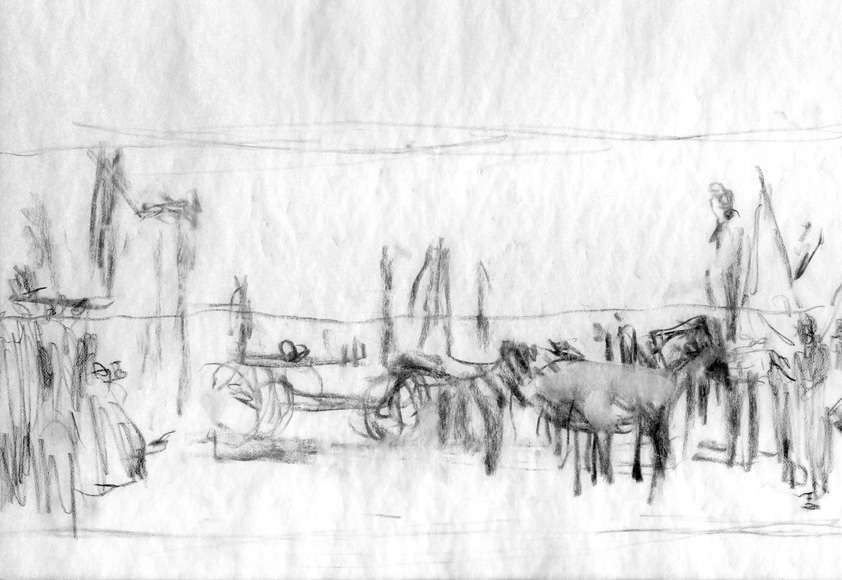
Mort Künstler likes to draw his final sketch on brown paper.He does this in order to highlight where the lighting effect will take place.
In the previous painting, “Road to Glory,” I showed Jackson leaving the Virginia Military Institute at the head of the Cadet Corps at the beginning of the war. In this piece “Last Tribute of Respect,” I once again show him leaving VMI for the last time…in his coffin. – Mort
Trying to include all the elements that would make a great painting, Mort Künstler created several preliminary drawings.
With the cooperation of Colonel Keith Gibson of VMI, he was able to obtain pictures of the era, important information about changes to the structure, and VMI military procedures.
For years I have been asked to paint sequels to some of my “Stonewall” Jackson paintings. Generally speaking, I have skirted around those requests while portraying other events in Jackson’s life that have intrigued me. That is, until now… - Mort Künstler
Mort starts each painting with sketches.It was difficult to settle on the angle he wanted to portray.
Considered one of America’s greatest historical artists, Mort Künstler has become well known for the extraordinary authenticity and drama of his work. Mr. Künstler has created paintings that educate and enrich the viewer’s understanding of some of the most important events in American history.




 Posts


